
Early-stage fintech funding, September 2026: $832 million, 62 rounds, and where South and Southeast Asia stands
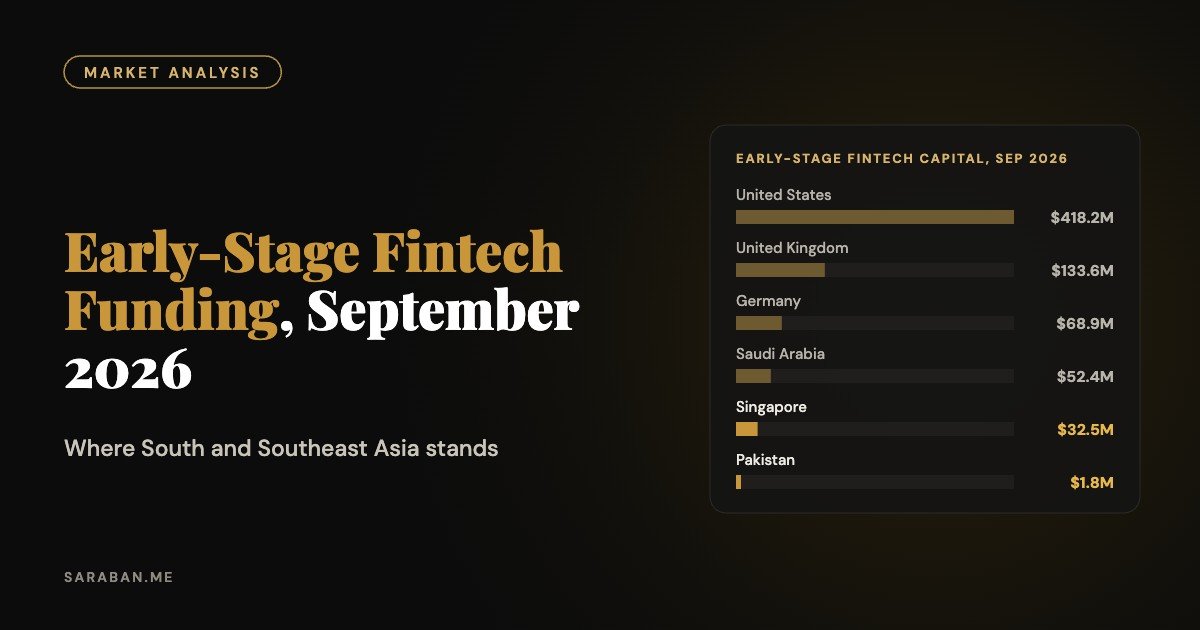
Early-stage fintechs raised $832.3 million across 62 rounds in September 2026. Four of those rounds went to companies in South and Southeast Asia, and three of the four were in Singapore.
One month of global funding data, read from Dhaka, Karachi and Jakarta: where the money went, what it bought, and the gap it leaves.
Early-stage fintech funding reached $832.3 million across 62 rounds and 20 countries in September 2026, according to the monthly tracker Mike Torro publishes with data from Freesbee Ventures. It was the busiest month in the series so far: 35 rounds were logged in August and 53 in July. The tracker covers pre-seed, seed and Series A, plus a handful of strategic and debt rounds, and it deliberately leaves out very large deals such as barq’s $329.5 million Series A in Saudi Arabia, which on its own would have been 28.4% of the month.
We read the same 62 rounds with one question in mind: what do they say about South and Southeast Asia? The short answer is that the region took about 4% of the month’s capital, almost all of it in Singapore, while Saudi Arabia and the UAE took twice as much. The longer answer is more useful, because the themes that attracted money elsewhere are the ones our markets need most.
Early-stage fintech funding in September 2026: the headline numbers
| Measure | September 2026 | Context |
|---|---|---|
| Rounds tracked | 62 | 35 in August, 53 in July |
| Capital tracked | $832.3M | Excludes barq’s $329.5M Series A |
| Series A | 22 rounds | 48.7% of capital |
| Seed | 24 rounds | Largest: OpenReserve and Corridor, $25M each |
| Pre-seed | 9 rounds | 8 of the 9 were AI companies |
| Strategic and other | 7 rounds | Credit facilities, a sukuk and blended deals |
| US share of capital | 50.3% | Down from 67.7% in July and 58.4% in August |
| Europe share of capital | 32.7% | 19 rounds, its best month in the series |
| Rest of the world | 17.0% | 18 rounds |
The US still takes half the money, but its share has fallen for three months running. Europe had its strongest month, helped by a credit facility of about $100 million in the UK; without it, Europe’s share would still be 20.7%, its highest in three months. Median round sizes tell the same story from another angle: $15.0 million in the US against $7.47 million in Europe, where the median has risen every month since July.
Artificial intelligence is everywhere but not dominant in dollars. AI companies were 45.2% of deals but took 37.7% of capital, the lowest share in three months. At pre-seed, AI is almost the whole market: eight of nine rounds.
Where South and Southeast Asia sits
| Company | Market | Round | What it does | Backers |
|---|---|---|---|---|
| iPiD | Singapore | $16M Series A | Checks that a payee account is real and matches the name before money moves | Foundation Capital (lead), Citi, HSBC |
| dtcpay | Singapore | $15M Series A extension (Series A total $25M) | Stablecoin payments and settlement; licensed by MAS as a Major Payment Institution | SBI Group, Vertex Ventures |
| QistBazaar | Pakistan | PKR 500M sukuk (about $1.8M) | Shariah-compliant instalment finance for household goods and technology | Alfalah Shariah Private Financing Fund-I |
| Laters.com | Singapore | $1.5M seed | Online travel agency with pay-later, wallet and crypto checkout | XBO Ventures |
That is $34.3 million, about 4.1% of the month. Take out QistBazaar’s sukuk, which is debt, and the region’s equity money was $32.5 million, all of it in Singapore. None of the 62 rounds went to a company in India, Indonesia, Bangladesh, the Philippines, Thailand or Malaysia.
One caution on the data. The tracker also lists Vietnam’s MFast with a $6 million Series A led by Wavemaker Partners. The only announcement of that round we can find is from August 2023, so we leave it out of the regional count. Hong Kong’s Infini, a $6 million seed round for stablecoin treasury and AI money management, is on the list too, but sits outside the region we cover.
For scale
Tracxn counts $53.3 million of seed and angel money into Southeast Asian fintech across all of January to September 2026, from 18 rounds, down 46% on a year earlier. Saudi Arabia’s four early-stage fintech rounds in this tracker raised $52.4 million in September alone. The two datasets define stages differently, so read this as an order of magnitude rather than a like-for-like comparison.
What the money bought: four themes
1. Stablecoin rails
Seven rounds went to stablecoin payments and settlement infrastructure: $140.5 million, 16.9% of the month. Six of the seven were American. Counting every crypto and stablecoin round, the share was 23.2%, the highest in three months. Singapore’s dtcpay is the region’s entry, and it is telling that it leads with its licences: a MAS Major Payment Institution licence at home and an e-money licence in Luxembourg. In Asia, the licence is part of the product.
2. Agents that do the back office
Nineteen rounds and $234.6 million, 28.2% of the month, went to what the tracker calls agentic finance: software that carries out finance work rather than advising on it. Most of it never meets a customer. 78.4% of agentic capital went to back-office execution such as bookkeeping, tax, audit, collections and loan operations. Five of the 19 operate inside a licence, as an audit firm, a mortgage broker, a benefits broker or a tax practice, and they took 41.7% of agentic money.
3. Verification for instant payments
iPiD’s round, backed by Citi and HSBC as both investors and customers, is a bet on a problem that real-time rails create. Once a payment is instant, it is also hard to reverse, so checking that the account exists and belongs to the intended payee before money moves becomes infrastructure. The company says it reaches more than 6,500 institutions in over 50 countries.
4. Islamic finance and Gulf capital
Three rounds were Islamic finance: Saudi Arabia’s erad (a $22 million Series A for SME lending), the UK’s Ayan Capital (a credit facility of about $100 million for Islamic auto finance) and Pakistan’s QistBazaar (a sukuk). Gulf investors such as MEVP, 500 Global and Wa’ed Ventures appear across the Saudi and UAE rounds. Saudi Arabia and the UAE together took $72.4 million from seven rounds, about twice South and Southeast Asia’s total.
Debt is now part of early-stage fintech funding
Five of the 62 rounds were not priced equity at all: Ayan Capital’s credit facility, Nigeria’s Nomba debt facility, QistBazaar’s sukuk, and the debt portions of Limetax and Tenora. Together they came to $141.9 million, 17.0% of the month. For lenders this is the normal shape of growth: equity builds the platform and debt funds the loan book.
QistBazaar is the regional example worth studying. A Pakistani instalment-finance company with more than 100 branches across 18 cities raised PKR 500 million through a privately placed, secured sukuk, the first tranche of a planned series, subscribed through a fund managed by Alfalah Asset Management. It shows Shariah-compliant lenders in Bangladesh, Indonesia and Malaysia a route to capital that does not depend on a venture round.
What this means for South and Southeast Asia
- The themes match the gaps. Back-office automation, payment verification and Shariah-compliant credit are exactly where small businesses in Dhaka, Karachi and Jakarta struggle. The products exist elsewhere; the local versions are not yet funded.
- Singapore is still the door most global early-stage money uses. Three of the four regional rounds were Singapore companies, consistent with Tracxn’s finding that Singapore took 83% of Southeast Asian fintech funding in the first nine months of 2026.
- Licences are the moat. dtcpay’s licences, iPiD’s bank customers and the licensed agents in the tracker all point the same way: regulated distribution is what investors are paying for.
- Gulf capital is the nearest new source. Investors already backing Islamic credit and SME lending in Saudi Arabia and the UAE are a natural fit for similar models in Bangladesh and Pakistan, whose remittance and trade ties to the Gulf run deep.
For the longer view on why so little capital reaches the region’s operating markets, read our market-size deep dive. We will track this tracker every month and report what changes.
September’s early-stage money went to stablecoin rails, back-office agents, payment verification and Islamic credit. Those are South and Southeast Asia’s gaps too. What the region lacks is not the problems; it is the early rounds.
Frequently asked questions
How much did early-stage fintechs raise in September 2026?
$832.3 million across 62 rounds in 20 countries, according to the Mike Torro and Freesbee Ventures tracker, which covers pre-seed to Series A plus some strategic and debt rounds.
How much early-stage fintech funding went to South and Southeast Asia in September 2026?
About $34.3 million across four rounds in Singapore and Pakistan, roughly 4% of the month. Three of the four were Singapore companies: iPiD, dtcpay and Laters.com.
What is agentic finance?
Software agents that carry out finance work on their own, such as bookkeeping, tax filing, collections or loan operations. In September 2026 they took 28.2% of early-stage fintech capital.
What is a sukuk?
A Shariah-compliant financing certificate, often used in place of a bond. QistBazaar raised PKR 500 million through a privately placed, secured sukuk in September 2026.
Which of these four themes gets the first big early-stage round in Bangladesh or Pakistan: back-office agents, payment verification, stablecoin rails or Islamic credit?
Share your view in the comments. This post is part of our monthly funding tracker, alongside a 50-part series on fintech in South and Southeast Asia; see the full series index.
Keep reading
Sources
- Mike Torro, “Outlook of Top Early-Stage Fintech Rounds in September 2026”, Mike’s Substack, 7 October 2026
- Freesbee Ventures, “Top early-stage fintechs raised funds in Sep 2026” (tracker graphic, October 2026)
- Crowdfund Insider, “Southeast Asia fintech funding triples to $2.3bn as mega-rounds dominate” (Tracxn SEA FinTech 9M 2026 report), 17 October 2026
- e27, “Citi, HSBC back iPiD’s US$16M round to make instant payments safer across borders”, September 2026
- Pulse 2.0, “dtcpay raises $25 million Series A as SBI Group backs regulated stablecoin payments platform”, 19 September 2026
- ProPakistani, “QistBazaar raises PKR 500 million through landmark sukuk issuance”, 2 September 2026
- e27, “Laters.com raises US$1.5M to expand flexible flight payments”, September 2026
- DealStreetAsia, “MFast Series A funding”, 29 August 2023
- PYMNTS, “Infini raises $6M seed round to scale its AI-powered global financial platform”, 22 September 2026
This article is for information and education only. It is not investment, legal or tax advice, and it is not an offer to sell, or a solicitation of an offer to buy, any security or interest in any fund. Market figures come from the third-party sources listed and may change; please check the original sources.