
South & Southeast Asia fintech market size: how to read the numbers, and the gap they reveal
Southeast Asia’s fintech market now moves more than $1 trillion a year. Yet the region still accounts for under 3% of the global fintech market. That gap is the story.
Big numbers about this market are easy to find. Numbers that mean the same thing are not. Here is how to read them.
Ask five analysts for the southeast asia fintech market size and you will get five answers, ranging from about $38 billion to more than $12 trillion. None of them is wrong. They measure different things: revenue, transaction volume, or the full value of money moving through a category.
This matters, because the way you size the market decides what you think the opportunity is. This deep dive separates the numbers, shows where the growth is coming from, and explains why such a large market still attracts a small share of global capital.
Three ways to measure the Southeast Asia fintech market size
Most headline figures fall into one of three buckets. Mixing them up is the single most common error in market decks about this region.
| Measure | What it counts | Typical SEA figure | Best used for |
|---|---|---|---|
| Transaction volume (GTV) | Total value flowing through fintech rails | About $1.07 trillion (2025 forecast) | Showing adoption and scale |
| Revenue pool | Fees, interest and premiums fintechs actually earn | About $38 billion (2025 projection) | Valuing companies |
| Category value | All money in a category, digital or not | $5 trillion+ (wealth), $12 trillion+ (payments, South and Southeast Asia) | Showing headroom |
The useful number for most people is the revenue pool, because that is what companies can capture. On that measure, Southeast Asian fintech revenue roughly tripled from about $11 billion in 2019 to an estimated $38 billion in 2025. Few regions in the world can show that.
Where the volume sits today
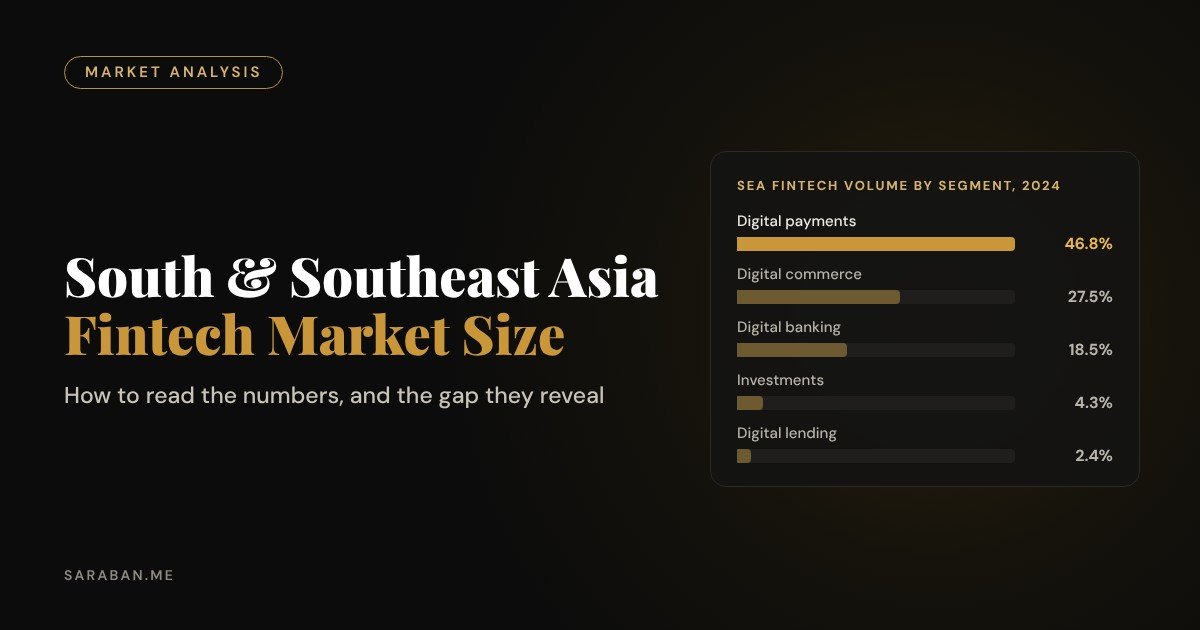
UnaFinancial estimates the Southeast Asian fintech market reached $907 billion in 2024. Payments dominate, but they are not where the fastest growth is.
The smallest segment is the one to watch. Digital lending is forecast to grow 40.1% in 2025, the fastest of any category, as credit reaches rural and underserved borrowers for the first time. Payments built the rails. Credit, insurance and savings are the products that run on them.
Why a trillion-dollar market gets so little capital
Between 2014 and 2024, Southeast Asia’s share of the global fintech market rose from 1.4% to 2.6%. It nearly doubled, but it is still a sliver of the total. Within Asia, the region holds about 5.4%.
Three objections usually explain the gap. Each one deserves a straight answer.
| Objection | What the data shows |
|---|---|
| “The region is unfamiliar.” | Unfamiliarity is an information gap, not a risk measure. The demand drivers (young population, mobile-first users, low bank access) are well documented. |
| “Regulation is too complex.” | Complex, yes, but navigable. Grab, Sea and GoTo built regional businesses across many regimes using holding-company structures. |
| “There is no exit route.” | Exits are real but mostly private. Secondary sales and trade sales make up the large majority of venture exits in the region; IPOs are rare. |
The result is a market where demand is growing faster than capital. For founders, that means less competition for the first customers. For investors, it means prices that still reflect the region’s reputation rather than its numbers.
The underbanked: the real size of the opportunity
The deepest measure of opportunity is not transaction volume. It is how many people still lack basic financial products.
Underbanked adults in SEA
85%
About 300 million people lack adequate access to financial services (Royal Park Partners, 2024).
Unbanked adults in Asia-Pacific
820M
Plus about 1.8 billion underbanked adults across the wider region.
Micro, small and medium enterprises tell the same story. They make up more than 97% of businesses in Southeast Asia, and most cannot get a formal loan. The market is large because the gap is large.
What this means in practice
A market growing at 18% a year with 300 million underserved adults does not need hype. It needs products built for people who earn irregular incomes, transact on mobile, and have never had a credit file.
How to read the next headline number
- Ask what it counts. Volume, revenue and category value differ by a factor of 30 or more.
- Ask which countries it covers. “Southeast Asia” usually means six markets; “South and Southeast Asia” adds India, Bangladesh, Pakistan and Sri Lanka.
- Ask what year and whether it is a forecast. Many figures are projections presented as facts.
- Look at growth by segment, not just the total. The fastest-growing segments are rarely the largest today.
Applied consistently, these four questions turn the Southeast Asia fintech market size from a slogan into a working tool. A founder can use it to size the revenue a product could realistically earn. An investor can use it to compare the region with others on a like-for-like basis.
What the numbers mean for founders and investors
For founders, the lesson is to build where the revenue pool is growing fastest, not where the volume is largest. Payments volume is enormous but margins are thin and incumbents are strong. Lending, insurance and wealth products are smaller today, earn more per customer and face far less competition.
For investors, the lesson is about timing. A region whose fintech revenue has roughly tripled in six years, while still attracting under 3% of global fintech activity, is priced on reputation rather than results. That mismatch rarely lasts. When it closes, it tends to close quickly, as it did in India after 2016.
The question is not whether South and Southeast Asian fintech is big. It is whether you are measuring the part of it that companies can actually earn.
Frequently asked questions
How big is the Southeast Asia fintech market?
UnaFinancial estimates total fintech market volume at about $907 billion in 2024 and forecasts $1.07 trillion in 2025. Fintech revenue, a narrower measure, is projected at about $38 billion for 2025.
What is the fastest-growing fintech segment in Southeast Asia?
Digital lending. It is forecast to grow about 40% in 2025, driven by credit reaching rural and underserved borrowers.
Why do market size estimates for SEA fintech vary so much?
Because they measure different things. Transaction volume, revenue earned by fintechs, and the total value of a category can differ by more than 30 times for the same market.
When you see a market-size figure in a deck, which do you trust more: transaction volume or revenue?
Share your view in the comments. This post is part of a 50-part series on fintech in South and Southeast Asia; see the full series index.
Keep reading
Sources
- UnaFinancial via finews.asia, “Southeast Asia fintech market set to surpass $1 trillion in 2025”
- Google, Temasek and Bain & Company, e-Conomy SEA report
- Fintech News Singapore, “Fintech Southeast Asia: the driving force behind its golden age” (Royal Park Partners data)
- World Bank, Global Findex Database
This article is for information and education only. It is not investment, legal or tax advice, and it is not an offer to sell, or a solicitation of an offer to buy, any security or interest in any fund. Market figures come from the third-party sources listed and may change; please check the original sources.