
Venture studio vs accelerator vs incubator: the structural difference
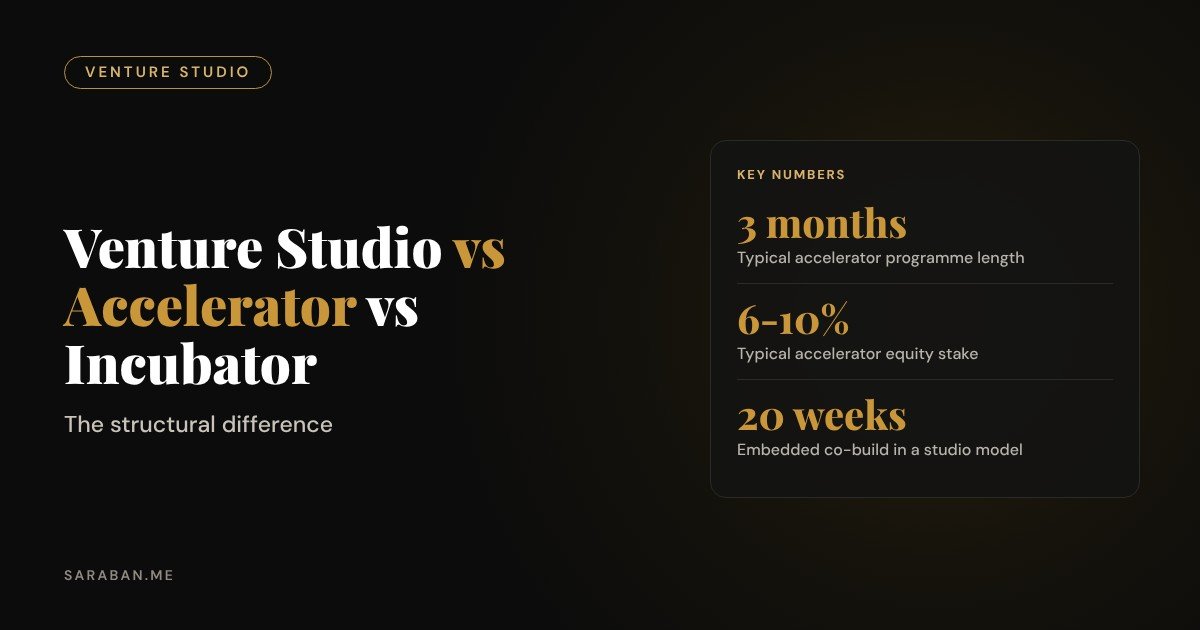
Venture studio, accelerator, incubator. The three words get used interchangeably, usually by people who have never built inside one. The differences are structural, and they compound.
Calling a venture studio an accelerator is like calling a hospital a gym. Both involve health. The similarity ends there.
The venture studio vs accelerator question is not about branding. It is about who carries execution risk in the first six months of a company’s life, and how much hands-on support comes with the capital.
This deep dive compares the three models on cost, involvement, outcomes and fit, and explains why the studio model is gaining ground in markets where experienced operators are scarce.
Three models, three different bets
| Feature | Incubator | Accelerator | Venture studio |
|---|---|---|---|
| Typical capital | Little or none | $20K-$150K | Larger initial cheque plus operating support |
| Duration | Open-ended | About 3 months | 4-6 months of embedded work, then ongoing |
| Equity taken | Often none | About 6-10% | Higher, reflecting deeper involvement |
| Who builds | Founder alone | Founder, with mentors | Founder and studio team together |
| Main output | Workspace and community | Network and demo day | Product, metrics and investor readiness |
| Portfolio size | Varies | 20-200 per year | A handful per cohort |
An accelerator is a filter and an amplifier. It finds promising teams, gives them a deadline and a network, and sends them to demo day. A studio is a co-builder. It sits inside the company while the hardest decisions get made.
Venture studio vs accelerator: where execution risk sits
Most early-stage failure is not about the idea. It comes from execution in a short window: finding product-market fit, getting unit economics right, and reaching the next round before cash runs out.
| Problem | Accelerator | Venture studio |
|---|---|---|
| Product-market fit | Founder works it out after the programme | Studio runs structured experiments with the founder |
| Unit economics | Covered in workshops | Built and stress-tested in the company’s own model |
| KPI design | Recommended | Set up in the first weeks and reviewed weekly |
| Fundraising | Demo day introductions | Narrative, data room and timing prepared together |
| After the programme | Alumni network | Continued operating support |
The accelerator model works well where operator talent is abundant and founders can hire experienced people quickly. In many emerging markets, that talent is scarce. The studio fills the gap by lending its own operators.
The economics, seen from both sides
For founders, a studio costs more equity. The question is whether the support is worth more than the dilution.
Accelerator logic
Breadth
Back many teams lightly and rely on a few outliers to carry the portfolio.
Studio logic
Depth
Back fewer teams heavily and reduce the chance that good companies fail for avoidable reasons.
For investors, the two models produce different portfolio shapes. Accelerator portfolios depend heavily on the power law. Studio portfolios aim for a higher survival rate, with fewer companies dying from preventable execution mistakes. Neither is automatically better; they suit different markets and different founders.
When each model fits best
- Choose an accelerator if you already have a technical team, early traction and mainly need network, credibility and speed.
- Choose an incubator if you are pre-idea or pre-team and need space, community and time to explore.
- Choose a venture studio if you have domain insight but need operating depth: product, data, finance and fundraising discipline.
- Avoid any model that cannot show you what founders who went through it are doing two years later.
A useful test
Ask any programme: “Who on your team will be in my product review in week six?” An accelerator will name a mentor. A studio should name an operator.
Why studios are rising in South and Southeast Asia
Fintech in this region is regulation-heavy, data-poor and distribution-dependent. A founder must handle licensing, build credit models without credit bureaus, and win trust from first-time users. These are exactly the problems an embedded operating team can shorten.
The Global Startup Studio Network has documented the model’s growth worldwide. In emerging markets, the argument is simpler: capital is scarce, operators are scarcer, and the studio supplies both at the same time.
That is why the venture studio vs accelerator debate looks different in Dhaka or Jakarta than in San Francisco. In a deep talent market, a founder can hire a head of risk or a growth lead in weeks. In a thin one, that search can take a year, and the company may not survive it. Lending operators for the critical first months is often the difference between a good idea and a working business.
Questions to ask before you join any programme
- What share of your companies raised a next round within 18 months?
- How many hours a week will your team spend inside my company?
- Which of your operators has built a regulated financial product before?
- What happens to support after the programme ends?
Capital without operating expertise at pre-seed is expensive guesswork. The studio model exists because that guesswork has a known failure rate.
Frequently asked questions
What is the main difference between a venture studio and an accelerator?
An accelerator runs a short, cohort-based programme of mentoring and networking. A venture studio embeds its own operators in the company for months and helps build the product, metrics and fundraising plan directly.
Do venture studios take more equity than accelerators?
Usually, yes. Studios take a larger stake because they contribute more capital and hands-on work. Founders should weigh that dilution against the support provided.
Is a venture studio better than an accelerator?
Neither is better in general. Accelerators suit founders who mainly need network and speed. Studios suit founders who need operating depth, especially in markets where experienced hires are hard to find.
If you have built through both models, what was the single most meaningful operational difference?
Share your view in the comments. This post is part of a 50-part series on fintech in South and Southeast Asia; see the full series index.
Keep reading
Sources
This article is for information and education only. It is not investment, legal or tax advice, and it is not an offer to sell, or a solicitation of an offer to buy, any security or interest in any fund. Market figures come from the third-party sources listed and may change; please check the original sources.