
Venture secondary exits: how liquidity really works in Southeast Asia
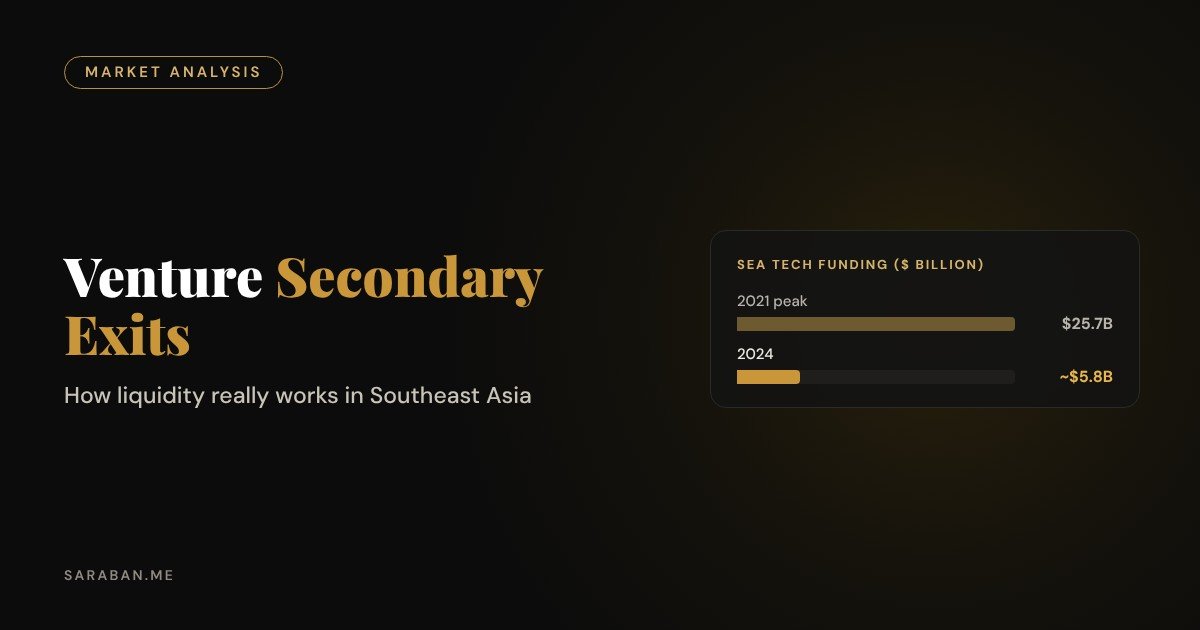
Southeast Asian tech funding fell by about 77% from its 2021 peak. Most people read that as a warning. Look at how exits actually happen and it reads differently.
When the tide goes out, the rocks appear. What the downturn reveals about liquidity is worth a close look.
Venture secondary exits, where an early investor sells shares to a later investor rather than waiting for an IPO, are the main way venture capital gets returned in Southeast Asia. That is not widely understood, and it changes how early-stage investing in the region should be evaluated.
This deep dive looks at what the funding decline actually changed, how exits are distributed, and what a secondary-led liquidity path looks like in practice.
What the 77% decline really changed
The headline is dramatic. The detail is more useful. Most of the money that left was late-stage growth capital, often from crossover investors who arrived in 2020-21 and priced rounds on momentum.
| Changed | Did not change |
|---|---|
| Late-stage valuations reset | Unbanked and underbanked populations |
| Founders now raise on unit economics | Mobile-first consumer behaviour |
| Fewer tourists competing for early deals | Government digital payment rails |
| IPO windows narrowed | Demand for credit, insurance and savings |
How venture secondary exits dominate the exit mix
Industry estimates for the region put secondary sales at around 71% of venture exits, with strategic acquisitions making up most of the rest and IPOs only about 3%. Figures vary by dataset, but the shape is consistent: liquidity in this market is mostly private.
Why private? Local stock markets are thin for tech listings, and US listings are expensive and slow. Meanwhile, regional growth funds, strategics such as super-apps and banks, and secondary buyers all want exposure to companies that have proven their model.
Update, October 2026: the pattern holds. In the first nine months of 2026 the region’s largest fintech exits were acquisitions, led by Grab’s $1.5 billion purchase of Atome and Circle’s $400 million purchase of TazaPay. There were no fintech IPOs, and the average time to acquisition rose to 6.3 years (Tracxn, SEA FinTech 9M 2026).
What a secondary-led path looks like
- Enter early, when valuations reflect risk rather than proof.
- Build the evidence: revenue, retention, unit economics and governance that a growth investor can underwrite.
- Sell part of the position when a later-stage investor leads a priced round and wants a larger stake than the primary round offers.
- Keep the remainder to participate in later upside.
This path does not need a public listing. It needs a company good enough that a later investor wants more of it, and early shareholders willing to sell a slice at a fair price. Our guide to early secondary sales covers the mechanics in detail.
Risks worth naming
| Risk | Why it matters | Mitigation |
|---|---|---|
| Buyer scarcity | If few growth funds are active, secondary demand falls | Build relationships with regional and strategic buyers early |
| Discounts | Secondaries often price below the latest round | Negotiate rights and timing in early documents |
| Transfer restrictions | Right-of-first-refusal and consent clauses can block sales | Use clean, standard shareholder agreements |
| Governance gaps | Buyers walk away from messy cap tables | Professional reporting from the first round |
The honest view
A downturn does not make early-stage investing safe. It removes the noise. The companies that raise in this market do so on fundamentals, which is exactly what later buyers want to see.
Who buys in a venture secondary exit
Understanding the buyers explains why venture secondary exits work here at all. Each buyer type wants something different, and an early shareholder’s job is to own the kind of position one of them wants.
| Buyer | What they want | When they buy |
|---|---|---|
| Regional growth funds | A larger stake than the primary round allows | Series A and B |
| Strategic investors (super-apps, banks, telcos) | Access to customers, data or a licence | Series A onward, often ahead of an acquisition |
| Dedicated secondary funds | Discounted entry into proven companies | Series B and later |
| Family offices | Direct exposure without a blind-pool fund | Any stage, opportunistically |
The common thread is evidence. Buyers pay for revenue, retention and clean governance. The decline in funding made that evidence more valuable, because there is less capital chasing companies that cannot show it.
How the downturn changed early-stage pricing
In 2021, early rounds were often priced off where late rounds were expected to land. When late-stage capital pulled back, that reference point disappeared. Early-stage pricing came back to what a company had actually achieved, and competition for pre-seed deals thinned out. For disciplined investors, entering at that point and planning for private liquidity from day one is a more realistic strategy than waiting for an IPO window that may not open.
The funding decline did not close the exit door in Southeast Asia. It showed that the door was always private, and always opened by fundamentals.
Frequently asked questions
What is a venture secondary exit?
It is when an existing shareholder, such as an early investor, sells some or all of their shares to another investor in a private transaction, instead of waiting for an IPO or acquisition of the whole company.
How do most venture investors exit in Southeast Asia?
Mostly through private transactions. Industry estimates suggest secondary sales account for around 70% of venture exits in the region, with IPOs only about 3%.
Did the funding decline make Southeast Asia less attractive?
It reduced late-stage capital and reset valuations. The underlying demand drivers did not change, and lower competition can make early-stage entry more disciplined.
Is the Southeast Asian funding decline a structural problem or a cyclical correction?
Share your view in the comments. This post is part of a 50-part series on fintech in South and Southeast Asia; see the full series index.
Keep reading
This article is for information and education only. It is not investment, legal or tax advice, and it is not an offer to sell, or a solicitation of an offer to buy, any security or interest in any fund. Market figures come from the third-party sources listed and may change; please check the original sources.