
Micro VC fund advantages: why fund size shapes strategy and returns
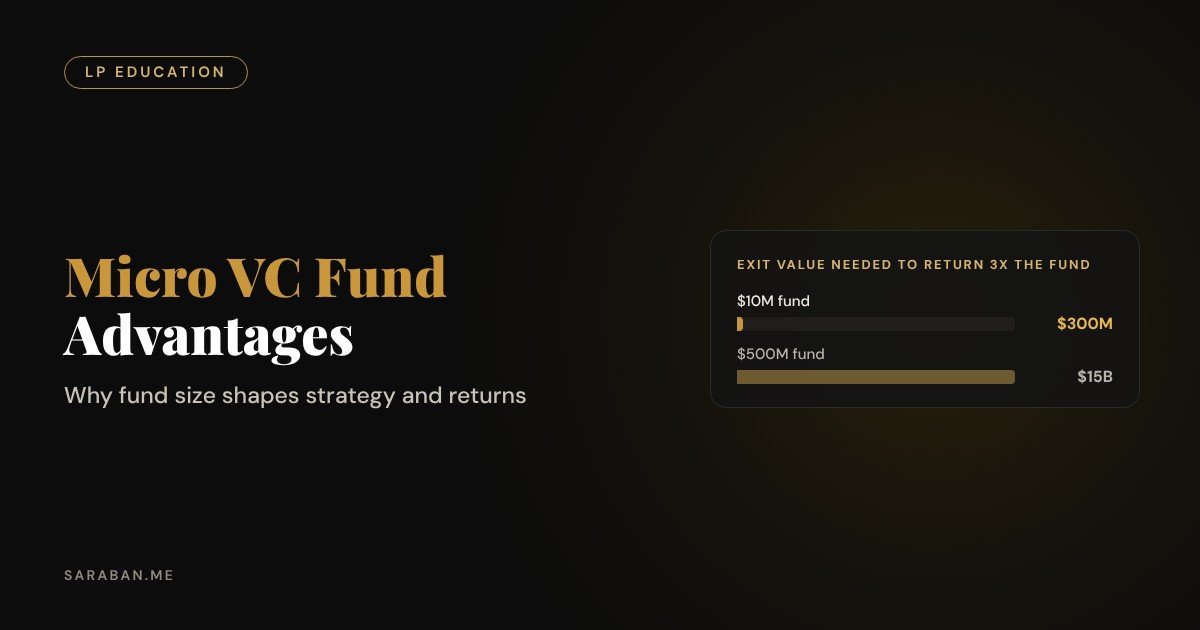
A $500 million fund and a $10 million fund both call themselves venture capital. They are playing different games, and the smaller one has advantages the larger one cannot buy.
Fund size is not just a number on a cover page. It decides which deals a manager can do, and what an outcome has to look like.
The advantages of a micro vc fund, usually defined as a fund under about $50 million, are often presented as a consolation for being small. They are better understood as maths. Fund size determines cheque size, cheque size determines entry stage, and entry stage determines what a successful exit has to look like.
This deep dive walks through that arithmetic, looks at what research says about small-fund performance, and sets out the trade-offs honestly. The examples are illustrative and do not describe any specific fund.
The arithmetic of fund size
Suppose two funds each aim to return three times their capital, and each expects to own about 10% of its winners at exit.
| $10M micro VC fund | $500M fund | |
|---|---|---|
| Target return to investors | $30 million | $1.5 billion |
| Ownership at exit (assumed) | 10% | 10% |
| Total exit value needed across the portfolio | $300 million | $15 billion |
| Number of $1B exits that would achieve it | Less than one | Fifteen |
A small fund can deliver an excellent result from outcomes that are common: a few companies selling for $100-300 million. A large fund needs several of the rarest outcomes in venture. In markets where billion-dollar exits are infrequent, that difference is decisive.
Why large funds cannot write small cheques
A $500 million fund with a team of ten partners cannot sensibly make 400 investments of $125,000. Each deal needs diligence, legal work, board time and follow-on decisions. The economics push large funds toward cheques of $5-20 million, which means entering at Series A or later.
Large fund
Series A+
Pays a price that already reflects proof of traction, typically several times the pre-seed price.
Micro VC fund
Pre-seed and seed
Enters while the price still reflects risk, and can lead the round.
Four structural advantages of a micro VC fund
- Entry price. Being able to lead small rounds means buying before the market re-rates the company.
- Selection discipline. With 20-30 companies, every decision matters. There is no room for “spray and pray”.
- Operating intensity. Small funds, especially those attached to studios, can spend real time inside each company.
- Local access. Managers who have worked in a market for years see founders who never pitch global funds.
The honest caveat
None of these advantages is automatic. A small fund with weak sourcing or no operating depth has the disadvantages of size and none of the benefits.
What the performance data suggests
Research from Cambridge Associates and other data providers has repeatedly found that smaller and newer venture funds show wider dispersion of returns than large, established funds. More of them land in the top quartile, and more of them fail.
| Feature | Smaller funds | Larger funds |
|---|---|---|
| Dispersion of returns | Wide | Narrower |
| Chance of top-quartile results | Higher | Lower |
| Chance of losing capital | Higher | Lower |
| Dependence on manager skill | Very high | High |
For investors, the implication is that micro VC fund selection is mostly manager selection. The structure creates the opportunity; the team decides whether it is captured.
The trade-offs
| Trade-off | Why it matters | How good managers handle it |
|---|---|---|
| Thin fee budget | Harder to pay an experienced team | Studio or platform model; partners invest their own time |
| Limited follow-on capacity | Ownership dilutes in later rounds | Reserve strategy and co-investment partners |
| Key-person risk | One or two partners carry the fund | Clear succession and governance |
| Less brand power | Harder to win competitive deals | Win on access and operating help, not brand |
A well-run micro VC fund treats these constraints as design choices, which is why the best small managers often look less like miniature large funds and more like specialised operating businesses.
Why size matters more in emerging markets
In the United States, billion-dollar exits are rare but frequent enough for large funds to plan around them. In South and Southeast Asia, most exits are smaller private sales to regional funds, banks and strategic buyers. A fund that needs fifteen billion-dollar outcomes to work is betting against the shape of the market. A fund that can do well on several $100-300 million outcomes is betting with it. That is the strongest argument for the micro VC fund model in this region: it matches fund size to the exits the market actually produces.
A small fund in the right market is not a smaller version of a large fund. It is a different instrument, built for a part of the market large capital cannot reach.
Frequently asked questions
What is a micro VC fund?
There is no fixed definition, but the term usually refers to venture funds under about $50 million that focus on pre-seed and seed investments with smaller cheque sizes.
Do smaller venture funds perform better?
Research suggests smaller funds show wider dispersion: more top-quartile results and more failures. Performance depends heavily on the manager.
Why do large funds invest at later stages?
Their size forces larger cheques. Making hundreds of small investments would be impractical, so they invest at Series A and later, when companies can absorb more capital.
In emerging-market pre-seed investing, is fund size a constraint or a feature?
Share your view in the comments. This post is part of a 50-part series on fintech in South and Southeast Asia; see the full series index.
Keep reading
Sources
This article is for information and education only. It is not investment, legal or tax advice, and it is not an offer to sell, or a solicitation of an offer to buy, any security or interest in any fund. Market figures come from the third-party sources listed and may change; please check the original sources.