Freelancer finance in Bangladesh: the income that banks cannot see
A developer in Dhaka earns $3,000 a month from clients in the United States, about ten times the national average. Her bank still cannot verify her income.
Bangladesh is one of the world’s largest suppliers of online freelance work. To the financial system, most of that income is invisible.
Freelancer finance covers the financial products people need when they earn from many clients instead of one employer: receiving international payments, smoothing irregular income, proving earnings to a lender, and saving for the long term. In Bangladesh, a country that supplies a large share of the world’s online freelance labour, almost none of these products exist in a form built for freelancers.
This deep dive looks at the size of the freelance economy, why banks treat platform income as invisible, and which products could change that.
The scale of Bangladesh’s freelance economy
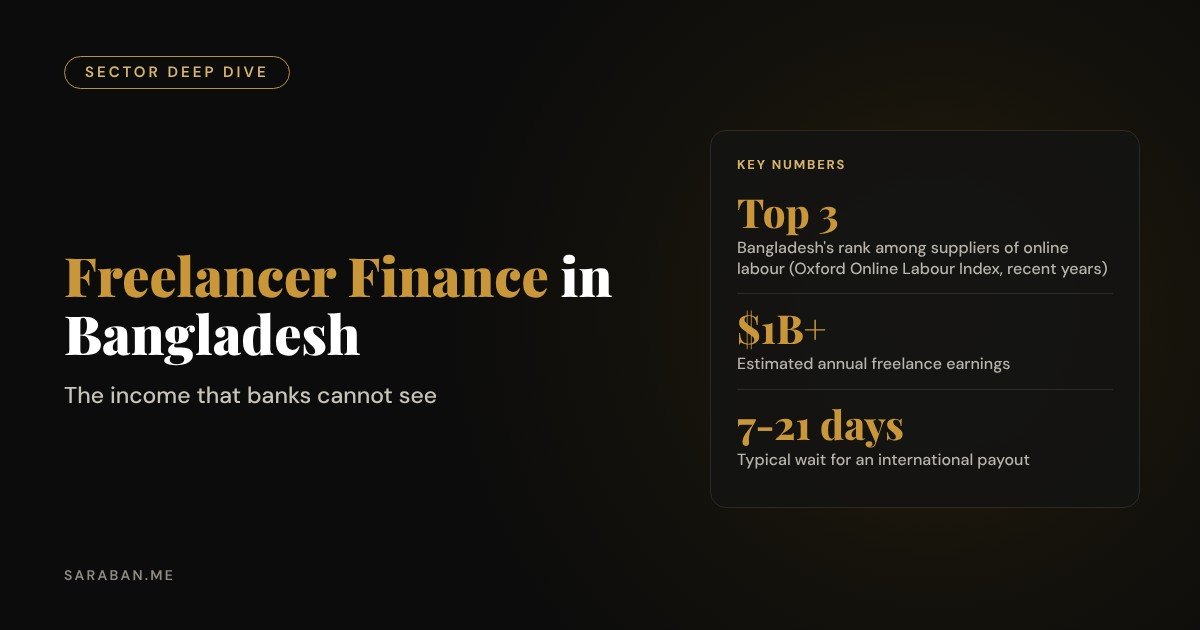
Estimates vary, but every source points the same way. The Oxford Internet Institute’s Online Labour Index has ranked Bangladesh among the very largest suppliers of online work, alongside India and Pakistan. Local industry bodies count more than a million registered freelancers, with somewhere around 650,000 regularly active.
| Indicator | Estimate | Note |
|---|---|---|
| Registered freelancers | 1 million+ | Industry estimates; active number is lower |
| Annual earnings | $1 billion+ | Growing quickly with remote work |
| Main work categories | Software, design, digital marketing, data entry | Higher-value categories growing fastest |
| Main payout routes | Payoneer, bank wires, local wallets | PayPal does not serve Bangladeshi receivers |
Why banks cannot see freelancer income
Bank underwriting is built around a payslip from a registered employer, deposited on the same day every month. Freelance income arrives in irregular amounts, in foreign currency, through intermediaries, from clients the bank has never heard of.
| Signal | Salaried worker | Freelancer |
|---|---|---|
| Income proof | Payslip and employer letter | Platform statements a bank may not accept |
| Regularity | Same amount, same day | Varies month to month |
| Currency | Local | Mostly US dollars |
| Employer check | Call HR | Dozens of overseas clients |
The result is that a high earner with a three-year track record can be rejected for a car loan while a lower-paid salaried employee is approved. That is not a judgement about risk. It is a gap in how risk is measured.
The data that already exists
Freelance platforms hold richer information than any payslip: earnings history, client ratings, completion rates, repeat clients and growth over time. Ride-hailing and e-commerce platforms elsewhere in the region hold similar data for drivers and sellers.
A payslip shows
One number
Monthly salary from one employer, at one point in time.
A platform profile shows
Years of data
Earnings trend, client diversity, ratings, disputes and consistency.
The question for freelancer finance is not whether the data is good enough. It is how to bring it to lenders with the freelancer’s consent, in a form they can trust. We explore the same idea for drivers and couriers in our piece on gig worker credit scoring.
Freelancer finance products worth building
| Product | Problem it solves | What it needs |
|---|---|---|
| Fast, low-cost payouts | 7-21 day waits and 5-8% costs | Licensed inbound remittance partner |
| Income verification | Banks cannot verify platform earnings | Consented data from platforms and payout providers |
| Earnings advance | Cash gaps between milestones | Visibility into approved but unpaid work |
| Dollar savings | Currency risk on earnings held in taka | Regulatory approval for foreign-currency accounts |
| Health and income insurance | No employer benefits | Micro-insurance partner and simple pricing |
The strongest freelancer finance business would start with payouts, because that is the moment money arrives, and then add verification, advances and savings on top of the same account.
Risks and open questions
- Platform dependence. Income can drop if a platform changes its fees or algorithms.
- Foreign exchange rules. Bangladesh controls how foreign earnings are held and converted; products must fit within central bank rules.
- Fraud. Fake accounts and manipulated earnings histories need detection.
- Tax clarity. Formal products may bring freelancers into the tax net, which some will resist unless the benefits are clear.
The bigger picture
Remote work is one of Bangladesh’s fastest-growing sources of foreign exchange. Building freelancer finance properly would keep more of that income in the formal economy and give a skilled generation access to credit for homes, education and businesses.
What good looks like in five years
Picture a freelancer who receives a client payment in minutes at a transparent rate, sees a verified income statement she can share with any lender, draws an advance against approved milestones, holds part of her earnings in dollars, and pays a small premium for health cover. Every piece of that exists somewhere in the world. Freelancer finance in Bangladesh needs someone to assemble it for one of the largest online workforces on earth.
The platform already knows exactly what a freelancer earns. Freelancer finance is the work of getting that knowledge to a lender, with her consent.
Frequently asked questions
What is freelancer finance?
It is financial services designed for people who earn from multiple clients rather than one employer, including international payouts, income verification, earnings advances, savings and insurance.
How many freelancers are there in Bangladesh?
Industry estimates count more than a million registered freelancers, with several hundred thousand regularly active. Bangladesh ranks among the largest suppliers of online labour globally.
Why can freelancers not get bank loans?
Banks rely on payslips and employer verification. Freelance income is irregular, paid in foreign currency through platforms, and often not accepted as proof of income.
Which product would change a freelancer’s financial life most: instant international payouts, a portable income record, or advances against approved work?
Share your view in the comments. This post is part of a 50-part series on fintech in South and Southeast Asia; see the full series index.
Keep reading
Sources
This article is for information and education only. It is not investment, legal or tax advice, and it is not an offer to sell, or a solicitation of an offer to buy, any security or interest in any fund. Market figures come from the third-party sources listed and may change; please check the original sources.