
Venture studio portfolio metrics: what to measure at month 24
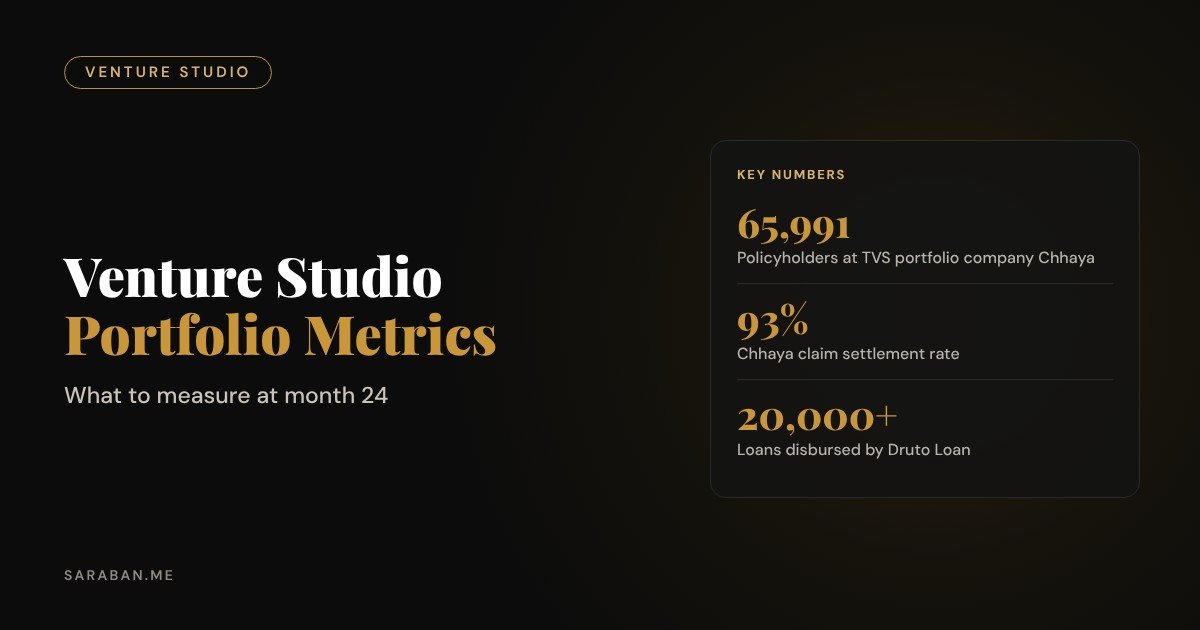
Paper valuations say little at month 24. Policies sold, loans repaid and customers retained say a great deal. That is what a studio portfolio should be judged on.
Two years after pre-seed, the operating numbers matter more than the marks.
Venture studio portfolio metrics should answer one question: are the companies building real businesses? At 24 months after a pre-seed investment, valuation marks are mostly opinion. Customers, revenue and repayment behaviour are evidence.
This case study sets out the operating metrics that matter at month 24, using two companies from the Turtle Venture Studio portfolio as worked examples, and explains why these numbers predict later outcomes better than any mark-to-model.
Why marks mislead early
At pre-seed and seed, a company’s value is usually set by its last funding round. That number reflects what one investor agreed to pay on one day. It can move a lot without anything changing in the business.
| Paper metric | Why it can mislead | Operating metric to use instead |
|---|---|---|
| Latest round valuation | Set by one negotiation | Revenue and revenue growth |
| Unrealised multiple | Not cash; depends on marks | Customers acquired and retained |
| Total capital raised | Raising is not earning | Unit economics per customer |
| Headcount | Cost, not output | Revenue per employee |
Venture studio portfolio metrics that matter
For fintech companies in particular, the right metrics depend on the product. Insurance, lending and payments each have a small set of numbers that reveal whether the model works.
| Model | Growth metric | Quality metric | Trust metric |
|---|---|---|---|
| Micro-insurance | Active policyholders | Loss ratio and renewal rate | Claim settlement rate and speed |
| Digital lending | Loans disbursed and volume | Repayment and default rates by cohort | Repeat-borrower share |
| Payments and wallets | Monthly active users | Transactions per user | Complaint and failure rates |
| Embedded finance | Partner integrations live | Revenue per partner | Partner retention |
Worked example: Chhaya, micro-insurance
Chhaya sells micro-insurance to people in Bangladesh’s informal economy, mainly through employers and community partners rather than direct advertising.
Growth
65,991
Active policyholders reached through embedded distribution channels.
Trust
93%
Claim settlement rate, the metric that drives renewals and referrals.
The settlement rate matters as much as the policy count. In a market where most people have never owned insurance, one unpaid claim can stop a whole factory floor from renewing. A high settlement rate is evidence that the product works for the people buying it.
Worked example: Druto Loan, digital lending
Druto Loan provides digital credit to borrowers that banks have underserved, using alternative data for underwriting.
- More than 20,000 loans disbursed, which gives the company enough repayment history to test and refine its risk models.
- More than $15 million in loan volume, showing the model works beyond a pilot.
- Expansion to the UAE, following the Bangladeshi diaspora, which tests whether the model travels across a corridor.
What to look for next
For any lender, the decisive numbers are cohort repayment curves: what share of each month’s loans is repaid on time, and how that changes as the book grows.
A month-24 scorecard
Taken together, venture studio portfolio metrics can be reduced to a short scorecard. It works for founders reporting to boards as well as for anyone evaluating a portfolio.
- Is revenue growing, and is it coming from customers who stay?
- Do unit economics work at the current scale, not just in a model?
- Is there evidence of trust: renewals, repeat use, referrals?
- Has the company raised its next round from investors who did independent diligence?
- Is governance clean: audited accounts, clear cap table, regular reporting?
Across the portfolio, companies have raised more than $6.34 million in follow-on capital after the studio programme, and annual revenue growth has averaged around 40%. Those are operating facts, and they are the right place to start any assessment.
What operating metrics cannot tell you
Good venture studio portfolio metrics are necessary, but they are not the whole picture. Three things need separate judgement.
- Market timing. A company can execute well in a market that is not ready, or slowly in one that is booming.
- Regulatory change. In fintech, a single licensing decision can open or close a market overnight.
- Founder resilience. The next 24 months are usually harder than the first. Metrics show what happened; they do not show how a team will handle the next shock.
The best boards read the scorecard and then ask what it does not show. That habit matters more than any single number, and it is the habit a studio should build into every company from its first board meeting.
At month 24, a valuation is an opinion. A paid claim, a repaid loan and a returning customer are evidence.
Frequently asked questions
What metrics should a venture studio report?
Revenue and growth, customers acquired and retained, unit economics, product-specific quality metrics such as default or loss ratios, and follow-on funding raised from independent investors.
Why are valuation marks unreliable for young startups?
Early valuations are set by a single funding round and can change sharply without any change in the business. Operating metrics show what the company has actually achieved.
What is a claim settlement rate?
It is the share of insurance claims an insurer pays out. A high rate signals that the product delivers on its promise, which drives renewals in first-time insurance markets.
When you look at an early-stage company at month 24, which single operating metric tells you the most?
Share your view in the comments. This post is part of a 50-part series on fintech in South and Southeast Asia; see the full series index.
Keep reading
- A startup KPI framework: why week two is not too early
- Why the venture studio model fits emerging markets
- InsurTech in South Asia: insuring the 99% who have never had a policy
Sources
- Company data from Chhaya and Druto Loan
- Carta, data on fund performance and fundraising
- Global Startup Studio Network
This article is for information and education only. It is not investment, legal or tax advice, and it is not an offer to sell, or a solicitation of an offer to buy, any security or interest in any fund. Market figures come from the third-party sources listed and may change; please check the original sources.