The healthcare financing gap in South Asia: a fintech problem, not a medical one
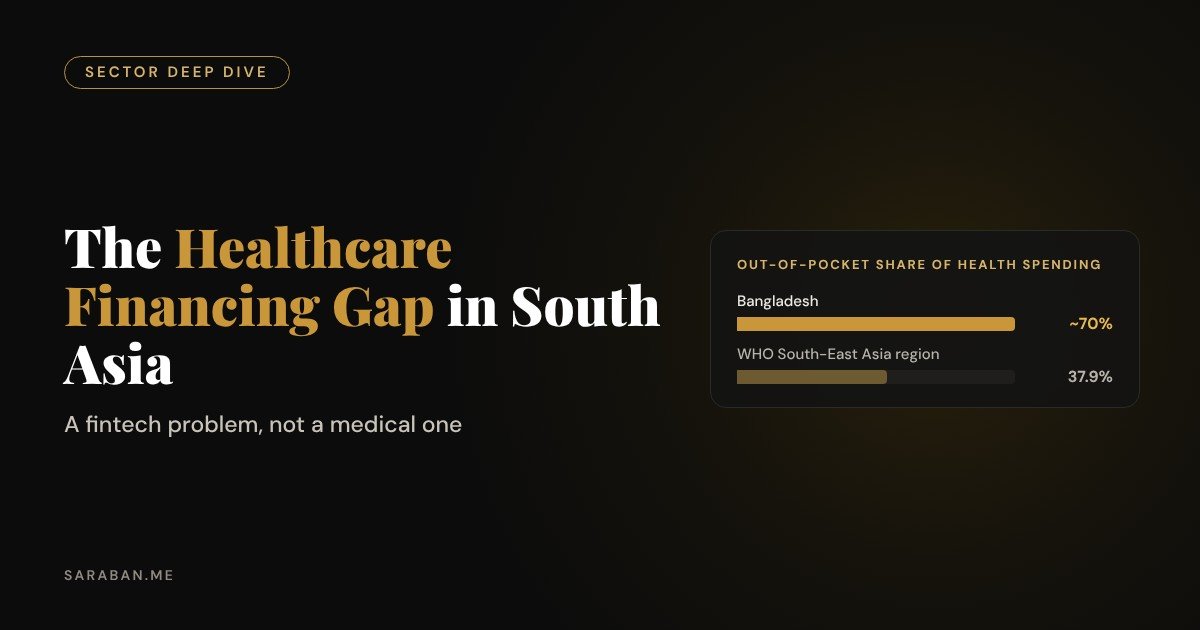
In Bangladesh, most health spending comes straight out of patients’ pockets. When a family faces a hospital bill, the options are savings, selling assets, or going without care.
Getting sick in South Asia is a financial emergency. That makes it a fintech problem as much as a medical one.
The healthcare financing gap is the distance between what care costs and what households can pay at the moment they need it. In South Asia it is wider than almost anywhere, because public insurance covers little and private providers deliver most care.
This deep dive sets out the numbers, explains why the gap persists, and looks at the fintech products that could close it: health micro-insurance, medical payment plans and financing for clinics.
How big is the healthcare financing gap?
A 2025 study in The Lancet Regional Health: Southeast Asia found that out-of-pocket (OOP) spending made up 37.9% of health expenditure across the WHO South-East Asia region in 2022, the highest of any WHO region. Government health spending averaged just 3.12% of GDP.
| Indicator | Figure | Source |
|---|---|---|
| OOP share of health spending, WHO SEA region | 37.9% (2022) | Lancet Regional Health SEA, 2025 |
| OOP share of health spending, Bangladesh | Around 67-73% depending on year | WHO GHED; PMC studies |
| Government health spending, regional average | 3.12% of GDP | Lancet Regional Health SEA, 2025 |
| Private providers’ share of outpatient visits (India, Bangladesh) | 60-80% | PMC, 2025 |
| Hypertensive adults facing catastrophic costs (Bangladesh study) | 46% | PMC, 2025 |
Why the gap is a financing problem
Consider a family in Dhaka facing a procedure costing BDT 150,000, with BDT 20,000 in savings. In many countries, a hospital would offer a payment plan or an insurer would cover much of the bill. In Bangladesh, the family usually sells assets, borrows informally or delays treatment.
- Bills arrive as a lump sum, while incomes arrive in small, irregular amounts.
- Medicines are the biggest cost. In Bangladesh, they account for more than half of OOP spending.
- Costs are rising. Average OOP spending among urban households rose from BDT 939 to BDT 1,605 a month between 2016 and 2022, even after adjusting for inflation.
- Insurance barely exists. Formal health insurance covers a very small share of the population.
Each of these is a mismatch between cash flow and cost, which is exactly what financial products are designed to fix. Seen this way, the healthcare financing gap is less about medicine and more about timing: households can often afford care over twelve months, but not on the day of admission.
Fintech products that can close the healthcare financing gap
| Model | What it does | Distribution | Key risk |
|---|---|---|---|
| Micro health insurance | Small monthly premiums for hospital and accident cover | Employers, mobile wallets, microfinance groups | Low awareness and trust |
| Medical payment plans | Spread a hospital bill over months | Hospital and clinic billing desks | Credit risk on new borrowers |
| Pharmacy credit and subscriptions | Monthly payments for chronic medicines | Pharmacy chains, telehealth apps | Adherence and churn |
| Clinic working capital | Short-term loans to small clinics and diagnostic centres | Supplier and payment data | Concentration risk |
The strongest models combine more than one. An insurer that also offers a payment plan for the uncovered part of a bill solves the whole problem at the moment of need, which builds the trust that drives renewals.
What early evidence shows
Micro-insurance distributed through trusted channels is working at scale in Bangladesh. TVS portfolio company Chhaya, for example, has reached 65,991 policyholders with a 93% claim settlement rate, by selling through employers and community partners rather than direct marketing.
Why distribution decides the outcome
People buy insurance from institutions they already trust. A factory, a microfinance group or a mobile wallet can do in one conversation what an advertising campaign cannot do in a year.
Questions any health fintech must answer
- How will claims be paid quickly? A slow first claim destroys trust for a whole community.
- Who verifies the provider? Fraud and overbilling are real risks in private care.
- How is the product priced for irregular incomes? Weekly or daily premiums often work better than monthly ones.
- What is the regulatory path? Insurance and lending both need licences or licensed partners.
Get these four right and the healthcare financing gap becomes a distribution problem rather than a product problem. The demand is not in doubt: almost every household in the region will face a medical bill it cannot pay at once. The question is who reaches them first with something they trust.
The healthcare financing gap in South Asia is not a shortage of hospitals. It is a shortage of ways to pay for them.
Frequently asked questions
What is the healthcare financing gap?
It is the gap between the cost of care and what households can pay when they need it. In South Asia it is large because most spending is out-of-pocket and insurance coverage is low.
Why is out-of-pocket spending so high in Bangladesh?
Public health spending is low, most care is delivered by private providers, and formal insurance covers a very small share of the population, so patients pay directly.
What fintech products help with health costs?
Micro health insurance, medical payment plans at hospitals, pharmacy credit for chronic medicines, and working-capital loans for small clinics are the main models.
Which health fintech product gets built first: hospital payment plans, micro-insurance at registration, or working capital for clinics?
Share your view in the comments. This post is part of a 50-part series on fintech in South and Southeast Asia; see the full series index.
Keep reading
Sources
- The Lancet Regional Health: Southeast Asia, primary health care financing in Bangladesh, Indonesia, Maldives and Nepal (2025)00084-8/fulltext)
- PMC, “Unmet healthcare needs, out-of-pocket payments and catastrophic health expenditures among hypertensive adults in Bangladesh”
- PMC, “Factors affecting out-of-pocket expenditures for chronic and acute illnesses in Bangladesh” (2025)
- World Health Organization, Global Health Expenditure Database
This article is for information and education only. It is not investment, legal or tax advice, and it is not an offer to sell, or a solicitation of an offer to buy, any security or interest in any fund. Market figures come from the third-party sources listed and may change; please check the original sources.