
The power law in venture capital: the maths behind every portfolio
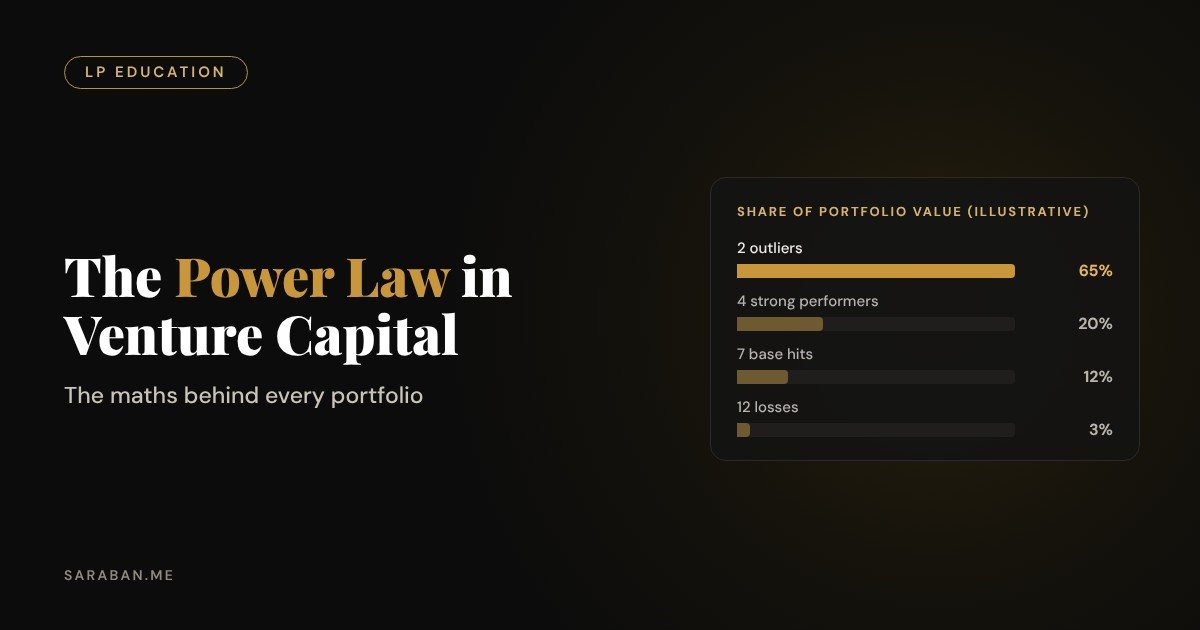
In a venture portfolio, a handful of companies usually produce most of the returns. That is not a slogan. It is how the distribution of outcomes works.
You cannot predict the outlier. You can build a portfolio that gives outliers room to appear.
The power law in venture capital means returns are not spread evenly across investments. A few outliers generate most of the value, while many investments return little or nothing. Data from firms such as Correlation Ventures and Horsley Bridge has shown roughly two-thirds of venture financings return less than the capital invested, while a small minority returning ten times or more drive the majority of gains.
This guide explains what that means for portfolio size, follow-on decisions and how investors should evaluate managers.
What the power law in venture capital looks like
Here is an illustrative 25-company early-stage portfolio with equal initial cheques. The numbers are hypothetical, chosen to show the shape of a typical distribution.
| Outcome group | Companies | Multiple on cost | Share of total value |
|---|---|---|---|
| Outliers | 2 | 20-40x | About 65% |
| Strong performers | 4 | 3-6x | About 20% |
| Base hits | 7 | 1-2x | About 12% |
| Partial losses and write-offs | 12 | 0-0.5x | About 3% |
Lesson one: portfolio size matters
If outliers are rare, a small portfolio may simply miss them. Holding more companies raises the probability that at least one outlier is included. The effect is strongest when moving from a handful of companies to twenty or more; beyond about thirty, each extra company adds less.
| Companies in portfolio | If 5% of companies become outliers | If 10% become outliers |
|---|---|---|
| 5 | 23% | 41% |
| 10 | 40% | 65% |
| 20 | 64% | 88% |
| 30 | 79% | 96% |
Lesson two: losses are capped, gains are not
The most an investment can lose is its cost. The most it can make has no fixed ceiling. That asymmetry is why venture managers tolerate many failures: one company returning 30 times its cost can cover a dozen write-offs and still produce an excellent fund.
Downside per company
-1x
The worst case is losing the amount invested.
Upside per company
30x+
A single outlier can return the whole fund several times over.
Lesson three: follow-on decisions concentrate returns
Because outliers drive the result, how much capital ends up in them matters as much as picking them. Funds keep reserves to invest more in their best companies in later rounds, which we cover in our guide to reserve strategy.
- Without reserves, a fund’s stake in its best company shrinks with each new round.
- With reserves, the fund can maintain or increase ownership where it matters most.
- The hard part is deciding early, often within two years, which companies deserve more.
How the power law in venture capital changes manager selection
| Question | Why it matters under a power law |
|---|---|
| How many companies will the fund hold? | Too few, and outliers may be missed |
| What share of capital is reserved for follow-ons? | Determines how much the fund benefits from its winners |
| How do you decide where to follow on? | Shows discipline, not just enthusiasm |
| Which past companies drove most of your returns? | Tests whether results come from one lucky deal |
| How do you source deals others do not see? | Outliers are often found before they are obvious |
The key takeaway for investors
Individual company selection is largely unpredictable. Manager selection is where investors have more control: sourcing, judgement, support and follow-on discipline are visible and testable.
Common misreadings of the power law
- “So any portfolio will do.” No. More companies only help if each has a genuine chance of becoming an outlier. Diversifying into weak deals adds losses, not lottery tickets.
- “Failures do not matter.” They do. Each write-off is capital that could have gone to a winner. Good managers still aim to reduce avoidable failures.
- “Only billion-dollar exits count.” In smaller funds, a company returning 20 times its cost can drive the whole result, even if its exit value is modest.
- “Angels can replicate this alone.” An individual investing in three or four companies is far less likely to hold an outlier than a fund holding 25, unless they keep investing steadily over many years.
The power law in venture capital is often used to justify risk-taking. Used properly, it is a discipline: it tells you to hold enough companies, reserve enough capital for winners, and judge managers on how they handle both.
You cannot predict which company becomes the outlier. You can choose portfolio size, reserves and managers that give the power law room to work.
Frequently asked questions
What is the power law in venture capital?
It is the pattern where a small number of investments generate most of a fund’s returns, while many investments return little or nothing.
How many companies should a venture portfolio hold?
There is no single answer, but early-stage funds commonly hold 20-40 companies to give themselves a reasonable chance of including outliers.
Why do venture funds keep reserves?
To invest more in their best-performing companies in later rounds, which concentrates capital where the power law says most returns will come from.
Do most private investors you know fully appreciate how the power law shapes the return they should expect from venture?
Share your view in the comments. This post is part of a 50-part series on fintech in South and Southeast Asia; see the full series index.
Keep reading
- Venture fund reserve strategy: the maths of following on
- IRR vs MOIC vs DPI: what each venture fund metric tells you, and what it hides
- Pre-seed valuation in emerging markets: why entry price decides the outcome
Sources
This article is for information and education only. It is not investment, legal or tax advice, and it is not an offer to sell, or a solicitation of an offer to buy, any security or interest in any fund. Market figures come from the third-party sources listed and may change; please check the original sources.